Related Content


Key Takeaways
How patient identification and empowerment can help people take the next step toward diagnosis and the right treatment
Picture two people in a pharmacy queue. The first has lived with type 2 diabetes for eight years. She collects her prescriptions on time and knows her blood sugar numbers well. Nobody has ever talked to her about her kidneys, and she has never thought to ask.
The second had a heart attack three years ago. He takes his statin every day, as prescribed. He isn’t sure what his cholesterol target is, or how far he is from it.
As far as either of them knows, they are not waiting for anything. That is the problem. Both are sitting in a waiting room they cannot see.
Who is still waiting to be recognised?
Patient identification is usually framed as a targeting problem, you just need to find the right people, then reach them. In my experience with pharma teams, many programmes either stop here or over-index here , because reach is the easiest thing to count.
But identification is really a chain, and it only creates value when every link holds together:
- Reach the people most likely to have an unmet need
- Make the information relevant and personal to them
- Help them recognise that it applies to them
- Give them the confidence, and the words, to act on it
- Make sure there is an assessment or review at the end
A programme that delivers the first link but not the last has found an audience, not a patient. So the more useful question for pharma is not "who should we reach?" but "what has to happen for reach to become recognition to become informed action?"
The first waiting room: before diagnosis
Some conditions announce themselves loudly. Others stay silent for years. Chronic kidney disease is one of the quiet ones, and it is far more common in people with diabetes. Guidelines recommend routine kidney checks for this group, yet many people never get them. A 2025 review of studies worldwide found that only around one in five high-risk adults with diabetes or high blood pressure had received the recommended test.
Of course HCPs should close this gap, but there is always a gap. This is where patient empowerment can make a vital difference. Relevant education can help someone understand why a kidney check matters and what to ask their doctor. It does not diagnose anything. Being on diabetes treatment doesn’t mean someone has kidney disease. It means they belong to a group where a check is worth discussing.
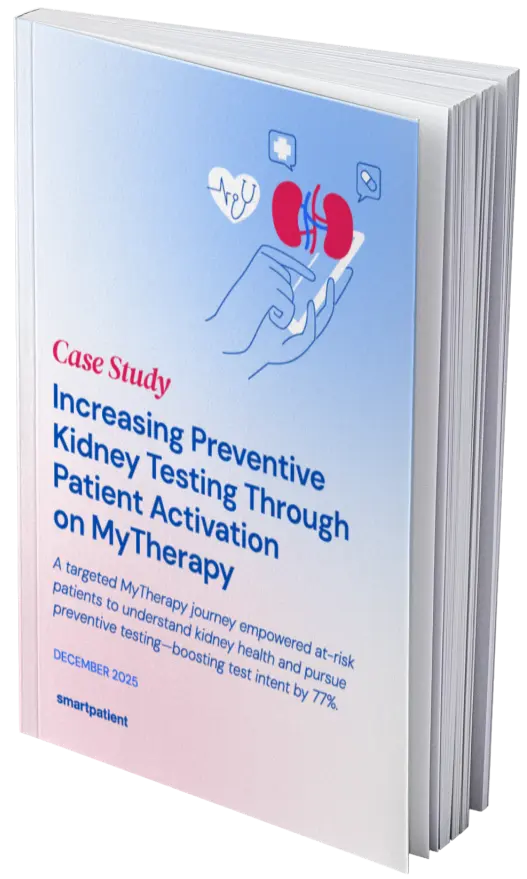
smartpatient tested this approach with an estimated 55,000 MyTherapy users at higher risk of kidney disease, over a three-month period. A short kidney health journey combined plain explanations, a quiz on personal risk and a checklist to take to the doctor. The company reports an estimated 77% increase in intent to get tested, compared with baseline.
Intent is not a completed test, and I will come back to that. But it is a meaningful first step, because the link most often missing in this chain is the patient knowing what to ask.
The hardest design choice is restraint. Education should help someone understand why a check matters and what to ask, without suggesting what the answer will be.

Florian Müller
Head of Product, smartpatient
Digital also has blind spots. The people at highest risk are often older, managing several conditions and less confident with apps. Reaching them means working with family members, pharmacists, nurses and GPs, not without them.
The second waiting room: when current care may need review
A diagnosis is not the end of the wait. Many people are on treatment yet still some way from their goals, often without knowing it. Cholesterol is a clear example. Across Europe, a majority of high-risk patients do not reach their recommended LDL targets.
Doctors call this clinical inertia: treatment is not stepped up even when goals are not met. The reasons are rarely simple. Appointments are short, priorities compete and, from the patient's side, nothing feels wrong.
Can an informed patient help? Yes, but with care. Knowing your numbers and your target turns a routine check-up into a specific question: "Am I where I should be, and if not, what are my options?" That is a question, not a demand. Treatment use, symptoms and readings all add context, but none of them on its own shows that a treatment has failed. The decision, including whether to step up to a stronger or add-on therapy, stays with the clinician.
There is also a fairness point. Empowerment should not quietly hand patients the job of fixing a system problem. It works best when the system meets them at least halfway, for example when the same signal that prompts the patient also prompts a review on the clinical side.
From identification to an informed next step
Pharma has spent the last decade learning an expensive lesson. Many single-brand apps and portals were built, launched and quietly abandoned, because patients had no reason to download one more app for one more product.
The alternative is to start where people already manage their health: pharmacy apps, medication managers, patient communities and insurer platforms. These already have reach and, importantly, the patient's permission. The opportunity is to add a relevant reason to take the next step.
For any approach like this, I would ask three questions:
- Does it reach the people with the greatest unmet need, not just the most engaged?
- Is the content clinically sound, approved and specific to the condition?
- Is there a real next step in that market, such as a test, a pharmacy check or a prepared consultation?
If the answer to the third is no, the programme is awareness, not identification.
Pharma doesn’t need to build a new audience for every initiative. Through MyTherapy and Redcare Pharmacy, we can reach people where they already manage their health. But reach is only the starting point. The opportunity is to help people recognize why an assessment or treatment review may matter, and give them the confidence to take that next step. Better clinical outcomes are the goal, and we need to measure what happens beyond engagement.

Marcelo Duhalde
Chief Growth Officer, smartpatient
Getting it right
For pharma, five things separate a credible programme from a well-intended one:
- Clinical relevance: outreach is based on clinically justified criteria. Medication or symptom patterns can inform who to reach, but they do not establish a diagnosis.
- Empowerment and choice: people understand how their information is used, can say no, and come away more confident to ask questions
- Accessible participation: content works across levels of health literacy, language and digital confidence, with human support for those the channel misses.
- An actionable pathway: every step leads towards an assessment or review, with diagnosis and treatment decisions staying with clinicians.
- Evidence of impact: success is measured in completed assessments, appropriate treatment decisions and patient-reported outcomes, not views, engagements and clicks!
If I had to pick the one that most threatens this approach, it is the last. It is tempting to stop at engagement or intent, because those numbers arrive quickly and look good. Even if we can’t reach the ideal goal of measuring improved patient outcomes, the minimum standard I would expect is to report how many people completed an assessment or review, not just how many said they would. That is also the natural next chapter for the kidney work above.
Patient-led action can open the door to earlier care, but it can't walk through it alone. Diagnosis and treatment decisions remain with clinicians. The ambition is better clinical outcomes, and we need evidence of what happens beyond engagement.

Amir Ali
Managing Director, smartpatient
Closing thought
Back to the pharmacy queue. Both people already had a relationship with their treatment and the place they collect it. What they lacked was a reason to ask, and the confidence to do so.
Patient identification should not end with a relevant audience or a flagged signal. Its value depends on what follows: an assessment, a timely review and, in the end, better outcomes. Clinicians confirm the diagnosis and decide the care. Patients can help get them into the room sooner.
For pharma, that means three shifts:
Find them earlier. Equip them better. Measure what happens next.
About Gary Monk
Digital Thought Leader | LinkedIn Top Voice
Connecting the dots on how AI, data, and digital platforms are reshaping pharma and healthcare in practice.
Turn patient identification into informed action
smartpatient helps pharma teams go beyond reach with relevant education and a clearer path to a clinical assessment or treatment review.